
Anger
What if you could "use" it, instead of it using you?

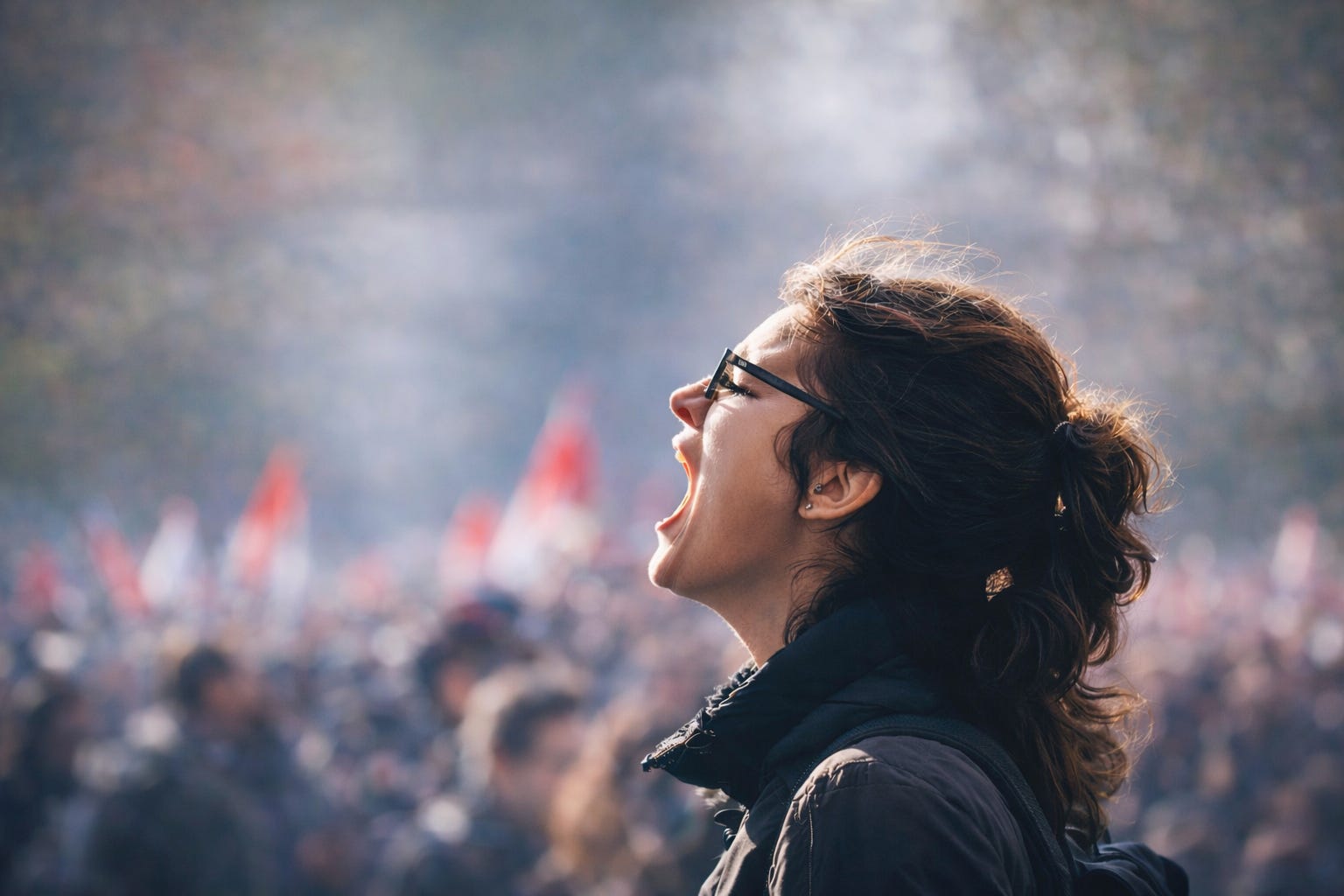
Dear friends,
I’m telling on myself today. My sweet, patient husband has, for quite some time now, been subjected to my running commentary, ranting and raving at the television, talking back to the radio as if it can hear me. If only I could direct these words at the person responsible for so much damage, I might feel better. Hmm…
I made a New Year’s resolution to curb my enthusiasm, but I’ve had a difficult time adhering to it. It feels as though the injustices are piling up so quickly that some days I can’t even remember the last thing I was raging about.
I am angry beyond anything I have ever known…at my former best friend, a close family member, and at the countless people in this country who have fallen prey to this regime. Don’t they see it? What is it that they cannot, or will not, understand? I’m angry at the heartless, the greedy, the power-drunk: people who care little for anyone but themselves, their influence, and their pocketbooks. I still find myself startled by the depth of cruelty that can exist so comfortably among us.
In past workshops with my mentor and friend, Debbie Ford, a core element of every training (and I did every single one on my path to becoming a trainer myself) included an anger-release session. Without fail, people were terrified to let loose. It was a process which was carefully structured, intentionally held.
It began with a long conversation designed to prepare participants for what was to come. Debbie always offered people the option to leave during this portion of the weekend. To their credit, few did. After the conversation, she would send everyone away in silence to consider what they were truly angry about - what lived underneath the polite surface. When participants returned, the room would be darkened, with ominous music filling the space. Everyone stood in their own area wearing blindfolds, while seasoned volunteers quietly monitored the room to ensure that, even at the height of the release, people remained safe.
The process drew from the work of Osho and his Dynamic Meditation. Breath work ignited the beginning: intense, rapid, deep inhalations and exhalations meant to charge the body with energy, loosen suppressed emotion, and awaken what had been buried. After a few minutes, the music changed, (Nine Inch Nails) loud enough to rattle the nervous system awake. The person leading the process began to shout into the microphone: all the reasons we might be furious to include past abuses, health crises, money troubles, parents, betrayal, broken promises. We heard it all.
Some people screamed at the people or institutions they’d never dared confront. Some sobbed. Some froze, motionless. A few tried to curl into a ball on the floor, but to prevent hyperventilation we would help them stand again. It probably felt like hours, though it was really only about fifteen minutes, until, at last, people were guided to lie down and simply breathe.
Then Debbie led a forgiveness meditation: not as a spiritual bypass, not as a denial, but as a release of the corrosive grip of blame toward ourselves and toward others. Often, a new perspective surfaced: much of what we call anger is an old wound finally breaking through the skin to insist that healing is needed. We left again in silence, returning to our rooms to journal. Most people found the process remarkably effective.
We all have an angry side. But especially for women, anger is treated as unacceptable…something unbecoming, something to swallow. So we compress it. We “manage” it. We smile through it. Until one day we can’t, and it spills out, often all over the people closest to us. When I first experienced this work, I was one of those people who insisted, “But I’m not angry.” I was deeply invested in being a nice, polite girl. Ha! Then Debbie asked me if I ever experience road rage. Of course I do, and there it was: my anger, alive and well, simply waiting for an outlet.
The process brought to light:
Awareness — identifying the source.
Acceptance — reclaiming your power and ending suppression.
Integration — releasing the energy it holds over you.
Forgiveness — of yourself and others, loosening the grip of blame.
Releasing anger is not a one-time event. At Challenge Day, a workshop for teens designed to interrupt bullying and separation, we asked students to imagine they had a balloon inside of them. Life happens: we spill the milk, fall off our bikes, get scolded for forgetting to clean our rooms. Each time, we blow a little upset…anger, sadness, shame…into that balloon. If we never empty it by talking with someone, moving the emotion, letting it out in a safe space, it fills to the brim. Eventually it bursts, and it tends to burst onto the people we love most. Why? Because those are the people we feel safest with, and the safest places are often where we leak what we refuse to face elsewhere.
The goal is not to stop being angry. The goal is to stop fearing your anger and instead let it teach you what you need, where your boundaries have been crossed, and what matters enough to defend. To turn it into a source of personal power.
But how do you use it? I believe we are not angry enough.
I’m not referring to the kind of anger that devours us from the inside out. Not the kind that turns us cruel, or numb, or addicted to outrage as entertainment. I mean the kind of anger that is clean, clear-eyed, values-based, and unwilling to normalize what should never be normal. The kind of anger that says: No. Not in my name. Not to my neighbors. Not to my children. Not to our future.
Because when we refuse to feel our anger, it doesn’t disappear. It just goes underground. It shows up as depression, exhaustion, doom-scrolling, cynicism, isolating, picking fights with the people we love, or collapsing into the familiar lie of, “What difference does it make?” Suppressed anger is exactly what authoritarians count on: a population too tired, too distracted, too discouraged to mobilize. Maybe they have us exactly where they want us…exhausted, struggling to keep our heads above water, and suppressed through fear.
So yes, why aren’t we out in the streets every day en masse? Why aren’t we flooding city council meetings, calling our representatives until they know our names, organizing carpools to the polls, donating ten dollars at a time, and building networks strong enough to hold real pressure? Why do we keep whispering in kitchens instead of speaking in rooms where decisions are being made?
Here’s the hopeful part: anger is not the enemy. Anger is energy. Anger is information. Anger is love with its boundaries crossed. It’s the part of you that still believes something is worth protecting.
The question isn’t whether we’re angry. The question is whether we’re willing to alchemize it.
Instead of letting it fester, what if we treated our anger like a flashlight and a fuel source?
Let it clarify your values. Name what you’re defending: voting rights, bodily autonomy, public education, equal justice, the environment, truth. Anger gets less toxic when it has a clear mission.
Give it a container. Pick one lane - one issue, one local group, one weekly action -so you’re not trying to carry the entire country on your nervous system.
Move it through your body. Walk, run, scream into a pillow, breathe like you mean it, shake it out, dance in your kitchen. Anger is physical. If it stays trapped in your body, it will trap you.
Convert it into community. Call one person and say, “I can’t hold this alone.” Join the meeting. Make the sign. Bring snacks. Offer rides. Volunteer for the unglamorous job. Democracy is rebuilt in small, consistent acts done together.
Practice “targeted outrage.” Not endless rage at the TV (I’m listening) but rage with direction. Ten minutes to read, ten minutes to act, then back to your life. Our nervous systems were not designed for 24/7 crisis; our movements are.
We cannot afford to wallow in this if indeed we are committed to keeping our democracy. But we also cannot afford to burn out. The work is to stay human: to feel fully, to act steadily, to rest intentionally, and to link arms, again and again, until the people who count on our silence realize we’re done being quiet.
Maybe we aren’t angry enough. Or maybe we haven’t yet learned how to make our anger useful.
I know many are using their voices, their talents, their money to make a difference. But, it will take all of us to mend the broken pieces. I’m reminded of my limits - I am human. I’m here to learn. I’m ready to show up. And if you are in a similar space, then let’s stop leaking our fury into our private lives and start turning it into public, peaceful, relentless pressure…together.
With resolve,
Donna
Dinner Topic Conversation: The “container” question: pick a lane without turning off your heart
Prompt: If you could only care (actively) about one issue for a year, what would you choose—and what would you stop doing to make room?
Your pieces really stand out in their ability to refocus us in our current dilemma towards ways to be more effective and more sane. Thank you for being who you are and doing all you choose to do. My focus is to elect Democrats because nothing else can happen without that and to use my writing and my voice to educate people about how Democrats have historically done things that made people’s lives better.
love how you teach and normalize anger and wished I'd had this all in my own hip pocket like 50 yrs ago+ and the balloon metaphor at least 30+ years ago for my kids