
We Normalize, They Weaponize
How an undefined “they” is created through language, accepted through repetition, and eventually given the force of government power.

Dear Democracy Defenders,
My late husband, Terry Lipman, used to say that whenever someone invoked the mysterious “they,” we should remember that “they are the biggest liars in the world.”
It was his humorous way of questioning claims such as “They say it isn’t safe,” “They don’t want us to know the truth,” or “They are destroying the country.” Who exactly are they? What did they actually say? And how do we know?
These days, Terry’s warning feels less like a joke and more like a diagnosis.
The word “they” can be stretched to include almost anyone. Immigrants. Journalists. Judges. Professors. Protesters. Democrats. Government employees. Anyone who challenges the story being told by those in power.
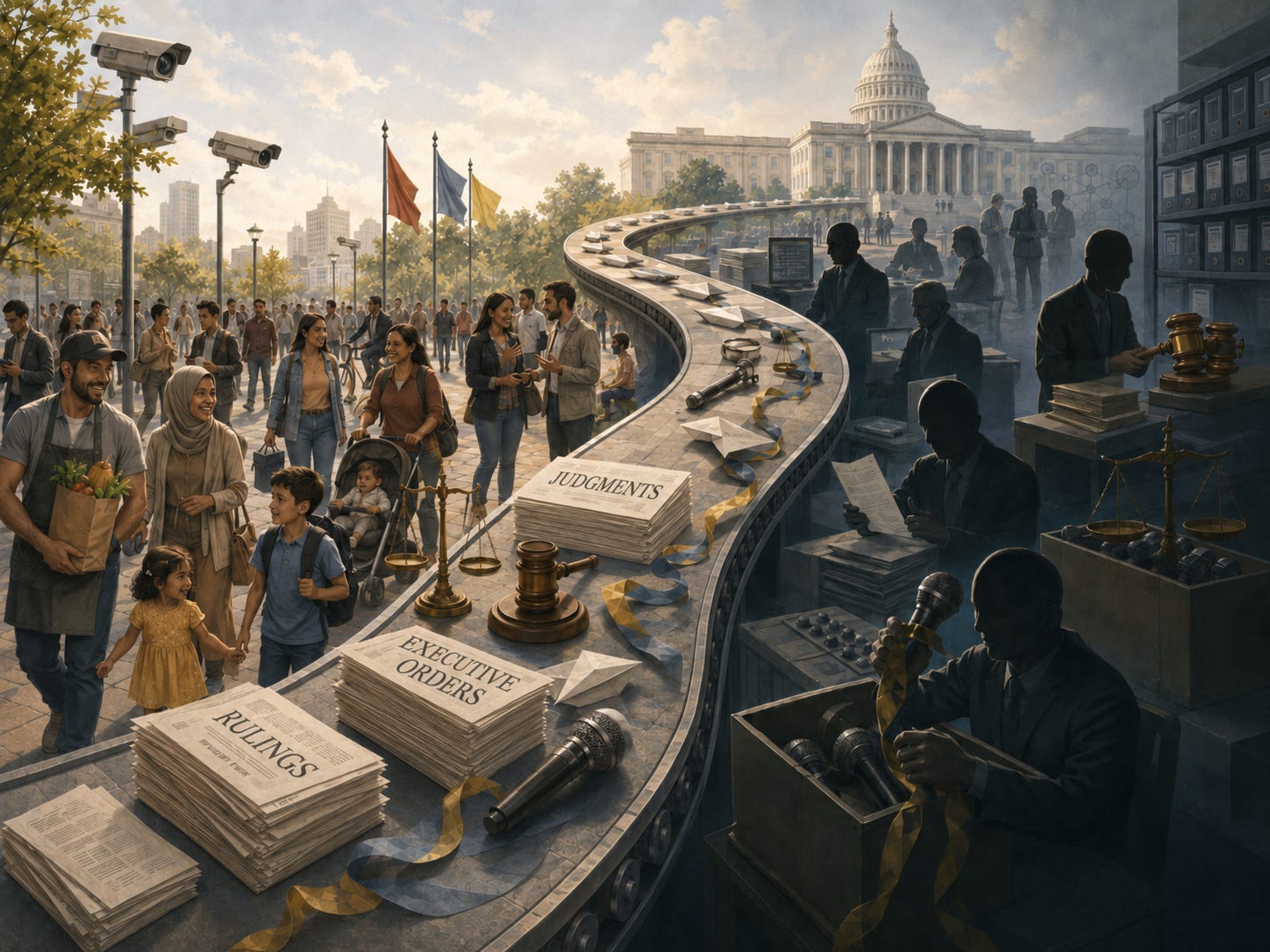
First, we are taught to fear “them.” Then we become accustomed to what is done to them. And eventually, the machinery used against them can be turned against us.
I recognize the irony in calling this essay “We Normalize, They Weaponize.” Terry would immediately ask me who “they” are. So let me be clear. I do not mean every Republican, every Trump voter, or every person who disagrees with me. I mean the president and members of his administration who are using the authority of the federal government to intimidate opponents, punish institutions, and redefine political disagreement as a threat to the nation. I also mean the political operatives, media personalities, and institutional leaders who help make that possible.
What’s the difference?
As I have been thinking about the difference between what we normalize and what this administration weaponizes, I’ve been reading Maggie Haberman and Jonathan Swan’s new book, Regime Change: Inside the Imperial Presidency of Donald Trump.
The title is important. They are not describing a routine change of administrations or a series of unrelated political battles. They are documenting a fundamental change in how presidential power is understood and used.
During Trump’s first term, there were still officials inside his administration who occasionally said no. Outside the administration, members of Congress, career public servants, universities, law firms, and media organizations retained more room to resist. In his second term, many of those restraints have been weakened, removed, or frightened into silence.
This is where normalization and weaponization meet. The public becomes accustomed to conduct that once would have been considered disqualifying. Meanwhile, the administration learns that every boundary crossed without meaningful consequences creates room to cross another.
Terry would still ask me to identify “they.” In this case, Haberman and Swan help identify who is making these decisions. These are not mysterious forces operating in the shadows. They are named people making identifiable decisions inside the White House and throughout the federal government. They include political advisers, most notably Stephen Miller, who develop pressure campaigns; officials who carry them out; and institutional leaders who decide whether to resist or comply.
Specificity matters because authoritarian language thrives on vagueness. “They” are destroying America. “They” are indoctrinating your children. “They” are communists. “They” are enemies.
Once we identify the actual people, policies and instruments of power involved, the fog begins to lift. We can stop arguing with a mythical enemy and start examining what our government is actually doing.
Normalization changes what we are willing to tolerate. Weaponization changes what those in power are able to do.
Normalization is gradual. Something happens that once would have shocked us. We protest. Then it happens again. Eventually, it becomes another headline competing with twenty others.
Weaponization is more deliberate. A label, law, federal agency, funding stream, prosecution, investigation, or military force is used to punish, intimidate, silence, or discredit a targeted person or group.
The danger is not only that we are being asked to believe false things. We are being trained to accept entire groups of people as threats. Once that belief settles into the national bloodstream, using government power against us begins to feel less alarming and sometimes even justified.
Let’s look at a few demonstrations of this theory.
1. Democrats become “communists,” then political opposition becomes illegitimate
This seemed a natural bridge from my previous article.
Calling Democrats communists is not simply name-calling. It changes their perceived status. They are no longer fellow Americans with different policies. They become an ideological infection or an internal enemy.
The administration’s official language has moved beyond ordinary partisan criticism. White House communications have described Democrats as “Radical Left lunatics,” portrayed the “Radical Left” as a terrorist threat, and announced a campaign to “crush Radical Left terrorism.”
When opposition becomes treason and disagreement becomes terrorism, the public is being prepared to accept actions against political opponents that would otherwise seem indefensible. That should concern us deeply as the 2026 midterms approach. Of course, I am not claiming that every Democrat will be prosecuted or silenced. The important point is that the category is being constructed. The language lays the groundwork.
2. Protest becomes “terrorism,” then military-style power appears ordinary
Official White House language has described some left-wing protest activity as terrorism and announced federal deployments to “crush” what it called radical-left violence. The administration also designated Antifa as a domestic terrorist organization, even though “Antifa,” shorthand for anti-fascist, has historically referred to a decentralized movement rather than a conventional membership organization.
During immigration protests in Los Angeles in 2025, the administration deployed National Guard forces over the objections of California officials. The government characterized the action as necessary to restore order; opponents described it as the militarization of domestic law enforcement.
We become accustomed to masked officers, troops in city streets, military vehicles near protests and elected leaders describing demonstrators as enemies of the country. Each image can allow the next deployment to feel slightly less extraordinary.
With my Safety Squad work, I have firsthand experience with demonstrations and know the difference between genuinely dangerous conduct and the behavior of ordinary people exercising First Amendment rights.
3. From “Indoctrination” to Intimidation
For years, conservative politicians and commentators have portrayed American universities as centers of liberal indoctrination. Students were supposedly being brainwashed. Professors were Marxists. Diversity programs were described as discriminatory. Campus protests became evidence that universities were dangerous, lawless or even anti-American.
Not every criticism of higher education is illegitimate. Universities should be questioned when they fail to protect students, tolerate antisemitism, restrict open debate or apply their own rules unevenly. But criticism and coercion are not the same thing.
The pattern works like this:
First, universities are described as corrupt institutions controlled by a dangerous ideological elite. The accusation is repeated until many Americans accept it as broadly true. Then the federal government uses investigations, research funding, student visas, accreditation and other forms of authority to force changes in university policies and leadership.
In Regime Change, Haberman and Swan place the administration’s campaign against universities within a much larger effort to pressure law firms, media companies and cultural institutions. Taken together, these actions do not look like separate attempts at reform. They look like a message - institutions that resist the president may pay a price.
The weapon is not only the loss of money. It’s fear.
One university sees what happened to another and begins changing its policies before receiving a threat. One law firm watches another lose access to government contracts and decides not to accept a controversial client. One media company fears regulatory retaliation and softens its coverage.
The administration does not have to control every institution directly. It only has to convince enough of them that independence is dangerous. And this pattern does not stop at universities. It extends to law firms, media companies, and cultural institutions.
My concern is not that universities should be beyond accountability.
It’s that government authority may be applied:
selectively against institutions viewed as politically hostile,
disproportionately to the alleged offense,
conditionally upon ideological or administrative concessions,
or publicly enough to frighten other institutions into compliance.
Why We Normalize: Self-Protection, Not Apathy
In my 25 years as a life coach, I am careful not to accuse ordinary people of simply being apathetic. We normalize for understandable reasons:
We are overwhelmed.
We cannot remain outraged every hour.
We assume courts or Congress will stop the worst actions.
We tell ourselves the target is someone else.
We adjust our language because sounding alarmed can make us seem hysterical.
Institutions comply because resistance may cost money, access, careers or safety.
Sociologist Diane Vaughan coined the term “normalization of deviance” while studying how unsafe organizational practices can gradually become accepted when disaster does not happen immediately.
Every boundary crossed without an immediate catastrophe becomes evidence that perhaps the boundary didn’t matter. The institution survives. The country continues. We have dinner, walk the dog, watch television and wake up the next morning. Because the roof has not yet collapsed, we begin to accept the widening cracks as part of the architecture.
Refuse to disguise it as normal
Here are some suggestions:
Name the specific person, order or agency rather than repeating a mysterious “they.” Preserve accurate language.
Notice when yesterday’s outrage has become today’s background noise.
Defend institutions and groups before they are personally connected to us.
Refuse anticipatory obedience in our own organizations and communities.
Terry was right about “they.” A mysterious “they” can be made to say anything, fear anyone and justify almost anything. The antidote is specificity. Who said it? Who ordered it? Who benefits? Who is being targeted?
We may not be able to stop every abuse of power the moment it begins. But we can refuse to help disguise it as normal.
Because what we normalize, they will weaponize. But what we clearly name, together we still have a chance to resist.
With eyes open and resolve intact,
Donna
Dinner Conversation Topic:
What is something that once seemed unusual but has now become completely normal in your lifetime?
You blow me away, Donna, with all your knowledge and subsequent wisdom. Jut last week I, too, went on a satirical tirade about they/them. I even find my mind saying/hoping “someone” will save us. Your words hit on so many emotions and I don’t even know how to respond to your intelligence, intuition, inquiry and courage to see it and call it out for others to recognize it, too. Thank you for being somebody who cares so deeply. Please keep us tuned in so we don’t weaponize our ownselves into ignorance and apathy. And when I or they don’t comment on your powerful messages, please know you are a voice for truth in these not normal times and you are heard. Glenda